
Drawing on the ideas of Berland and Lee’s work looking at computational thinking in the board game Pandemic, below is a group activity that I put together as part of a cross curricular math, technology, and language arts lesson. It involves working in a group to play and analyze a board game using the principles of computational thinking. The group begins by selecting a game, learning its rules through a video and reading, and playing a practice round to ensure everyone understands how it works. Once the game is underway, members take turns completing a worksheet and concept map that guide discussion around key computational thinking elements: decomposition, pattern recognition, abstraction, debugging, simulations, and algorithms. The goal is to reflect on the game’s mechanics, strategies, and design while identifying patterns, breaking down tasks, and developing step-by-step strategies for success. After finishing the game, the group reviews their responses and participates in a debrief discussion before submitting their work and sharing with the class.
Berland, M., & Lee, V. R. (2011). Collaborative strategic board games as a site for distributed computational thinking. International Journal of Game-Based Learning (IJGBL), 1(2), 65-81.
Board Game Analysis with Computational Thinking
Group Members:
Game:
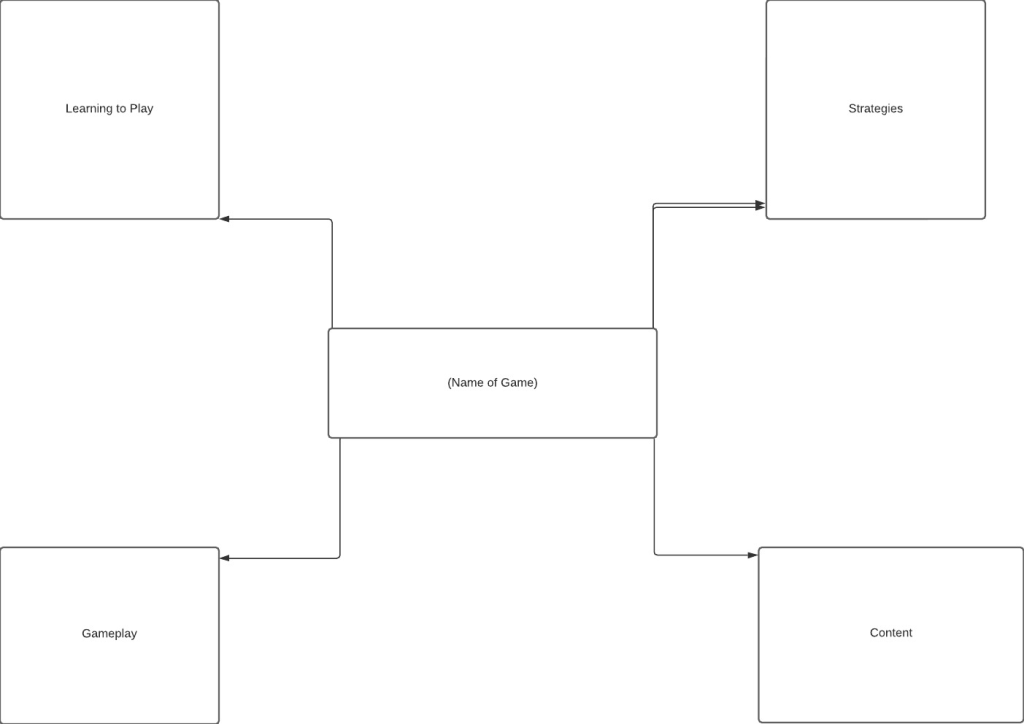
As you play your chosen game, keep track of your discussions and experiences in the concept map below. Follow the instructions in class and on this sheet. Complete the attached handouts as you play. Do this as a group.
- Choose a board game to play and read over this assignment as a group.
- Learn to play the game by watching a “How it’s played video on YouTube” and have at least one member of your group read the rules
- Play a practice round of the game.
- Discuss with your group if you interpreted the rules correctly. Revise what you need to.
- Play the game and take turns completing the sheet. You should have an open discussion as you play regarding the questions on the sheet.
- After the game is complete, review your answers as a group. There will be a debrief discussion, submit your work.
Elements of Computational Thinking
- Decomposition
- Pattern Recognition
- Abstraction
- Debugging
- Simulations
- Algorithms
Complete this concept map as you play the game. Write down your thoughts, ideas, and discussions. Think about if the game was easy to learn, what strategies did you use, what kinds of content (story, art, theme) does the game have, what is the gameplay like?
Board Game Computational Thinking Analysis
Name:
Date:
- Decompose the game, and indicate your tasks, goals, actions, and win conditions.
- Task:
- Goals:
- Actions you can take:
- Win Conditions
- What patterns or similarities repeat themselves throughout the game?
- Pattern 1
- Pattern 2
- Abstraction: What details in the game are irrelevant to the goals? What actions are necessary to be successful?
- Algorithms
- What strategies did you employ? What was successful? Did you revise this?
- As you learned to play did you have to debug your understanding of the rules or instructions while you played?
- Provide step-by-step instructions as to how to be successful when you play the game?
1.
2.
3.
4.
The four cornerstones of computational thinking
There are four key techniques (cornerstones) to computational thinking:
- decomposition – breaking down a complex problem or system into smaller, more manageable parts
- pattern recognition – looking for similarities among and within problems
- abstraction – focusing on the important information only, ignoring irrelevant detail
- algorithms – developing a step-by-step solution to the problem, or the rules to follow to solve the problem

 Multimedia, Technology, Video Games, and Learning